

The honest truth most comparison guides will not tell you
Most "India vs Thailand" articles online are written by hospitals or facilitators who have already decided what conclusion they want you to reach. They list their own destination's advantages and mention competitors only in passing.
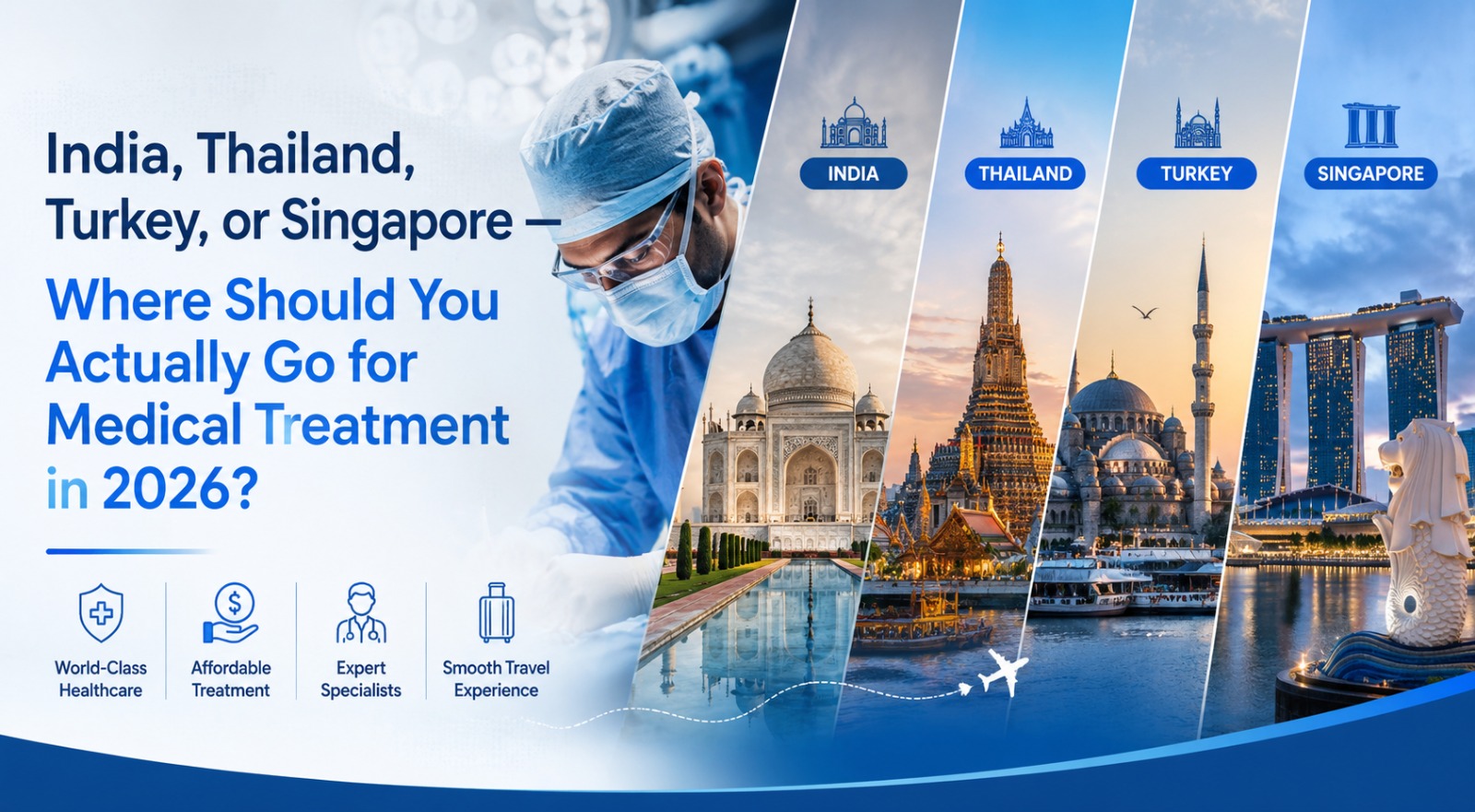
This article is different. All four destinations — India, Thailand, Turkey, and Singapore — genuinely offer good medical care. Each one has real strengths and real limitations. And the right answer for you depends on what condition you have, where you are traveling from, what your budget is, and what kind of support you need on the ground.
If you are a patient from Nigeria, Kenya, Ghana, Oman, or Saudi Arabia trying to make this decision — here is an honest, detailed breakdown of what each destination actually offers, where each one falls short, and how to figure out which one is right for your specific situation.
Cost — The First Filter for Most Patients
Before anything else, most patients want to know what the treatment will cost. Here is a realistic comparison across the four destinations for the most commonly sought procedures, using all-inclusive estimates from accredited hospitals:
Procedure India Thailand Turkey Singapore Heart Bypass (CABG) $4,500 – $6,500 $12,000 – $18,000 $8,000 – $12,000 $18,000 – $30,000 Total Knee Replacement $3,700 – $5,500 $9,000 – $14,000 $7,000 – $10,000 $15,000 – $25,000 Liver Transplant $28,000 – $45,000 $45,000 – $75,000 $35,000 – $55,000 $70,000 – $100,000 Bone Marrow Transplant $20,000 – $35,000 $35,000 – $60,000 $25,000 – $45,000 $60,000 – $90,000 IVF (single cycle) $2,000 – $3,500 $4,000 – $7,000 $3,000 – $5,000 $8,000 – $14,000 Spine Surgery $5,500 – $9,000 $12,000 – $18,000 $8,000 – $14,000 $18,000 – $35,000 Hip Replacement $5,000 – $7,000 $11,000 – $16,000 $8,000 – $12,000 $16,000 – $28,000
A few things stand out immediately. India is not just cheaper than Western countries — it is significantly cheaper than Thailand and Turkey for the same procedures at the same accreditation standard. Singapore sits in its own bracket, with costs that rival private hospitals in the UK.
The cost difference between India and Thailand for something like heart bypass surgery is not marginal — it is $8,000 to $12,000 on a single procedure. For a Nigerian or Kenyan patient who is self-funding through savings or family contributions, that difference is life-changing.
One important note on these numbers: always ask what is included in the estimate before comparing prices across destinations. An Indian hospital estimate that includes surgeon fee, theatre charges, ICU stay, implant, and physiotherapy is not directly comparable to a Thai estimate that covers only the procedure itself.
What Each Destination Is Actually Best At
Cost matters — but it is not the whole picture. Each destination has built its medical tourism reputation around specific strengths, and knowing what those are helps you match your condition to the right place.
India — The Widest Range at the Lowest Cost
India's strength is breadth and depth at the same time. You can get a knee replacement, a liver transplant, a bone marrow transplant, a complex cardiac repair, advanced cancer care with proton therapy, robotic spine surgery, or IVF — all at NABH and JCI accredited hospitals, all at costs that no other destination can match for equivalent quality.
For complex, high-stakes procedures — multi-organ transplant, advanced blood cancer treatment, paediatric cardiac surgery, neurosurgery — India's top hospitals carry a volume of specialist experience that simply does not exist at comparable price points anywhere else in the world. A cardiac surgeon at Fortis Escorts Heart Institute who has performed over 30,000 procedures represents a depth of experience that a counterpart in Bangkok or Istanbul — however skilled — has not had the patient volume to accumulate.
India's limitation is that it is not glamorous. The experience of recovering in India is functional and well-supported — not luxurious. Patients who prioritize hotel-quality accommodation and a resort-like recovery environment may find Thailand or Singapore more comfortable.
Thailand — Strong for Elective and Cosmetic Procedures
Thailand built its medical tourism reputation on specific strengths: cosmetic surgery, dental procedures, gender-affirming surgery, general wellness, and health checkups. Bumrungrad International in Bangkok handles a broad range of complex cases and has an excellent international patient department.
Where Thailand falls short relative to India is in specialist depth for high-complexity procedures. Bone marrow transplant, multi-organ transplant, complex congenital heart repair — India's hospitals handle these at a volume that most Thai hospitals cannot match, and at significantly lower cost.
Thailand is a good choice if your procedure is elective, cosmetic, or dental. It is a less optimal choice if you need complex cardiac surgery, transplant, or advanced oncology, where India's specialist infrastructure is stronger and cheaper.
Turkey — Best for Hair, Dental, and Cosmetic from West Africa
Turkey has become a genuinely strong destination for hair transplant, dental veneers, cosmetic surgery, and eye procedures. Istanbul's private hospitals are modern, English-capable, and well-organised for international patients. Turkish Airlines also offers direct flights from Lagos — which makes Turkey the closest of the four destinations from West Africa.
For cardiac and orthopedic procedures, Turkey's private hospitals are competent. But they do not carry the specialist volume that India's top hospitals do. A patient needing a straightforward knee replacement might reasonably consider Turkey. A patient needing revision knee surgery, a complex bypass, or an organ transplant is better served by India's deeper specialist experience.
Turkey also has a language consideration for African patients. While international hospital departments speak English, ward-level communication for in-patients is typically Turkish, which adds friction during recovery.
Singapore — Exceptional Quality at an Exceptional Price
Singapore is genuinely one of the best places in the world to receive medical treatment. Its hospitals are impeccably run, its specialists are world-class, and the overall experience is seamless. It is also extremely expensive — and for most self-funding patients from Africa or the Middle East, the cost premium over India is difficult to justify when India's accredited hospitals produce equivalent outcomes for the majority of procedures.
Where Singapore makes sense is for highly specific situations: a complex neurological case requiring technology not yet available in India, a patient with insurance coverage that makes cost less relevant, or a case where the specific specialist a patient has been recommended practices in Singapore rather than India.
For the vast majority of cardiac, orthopedic, transplant, and oncology cases where an Indian hospital is equally qualified — Singapore's cost premium does not buy meaningfully better outcomes.
Language — More Important Than Most Patients Realise
Nobody wants to wake up from surgery in a country where they cannot communicate with the nurse standing next to them.
India: English is an official language and the working language of every major hospital. Doctors, nurses, coordinators, and administrative staff all communicate in English at every level — not just at the international patient desk. For patients from English-speaking Africa — Nigeria, Kenya, Ghana, Zimbabwe, Sierra Leone, Namibia, Botswana — there is no language barrier at any point in the clinical process. For patients from the Gulf, Arabic-speaking coordinators are available at major hospitals including Apollo and Medanta, which have maintained long relationships with Saudi, Omani, and Emirati patients.
Thailand: Thai is the clinical language. International patient departments at hospitals like Bumrungrad are English-capable. Ward nurses and supporting staff, however, are primarily Thai-speaking. A patient recovering over several days in a Bangkok ward may find day-to-day communication more difficult than expected — particularly for explaining symptoms, asking for medication, or understanding post-operative instructions.
Turkey: Turkish is the clinical language. The same pattern applies as Thailand — English at the international department, Turkish at ward level. For patients from Francophone Africa who speak French rather than English, some Turkish hospitals offer French-speaking staff, which is a niche advantage.
Singapore: English is widely spoken at all levels. No language barrier. The cost premium, however, remains the defining factor for most patients.
For African patients specifically — particularly those traveling with elderly family members who may be less comfortable navigating foreign environments — India's English-language environment at every level of care is a practical advantage that is hard to overstate.
The Medical Visa — What Getting In Actually Involves
The visa process determines how quickly you can move from diagnosis to treatment. For patients dealing with a time-sensitive condition, a complicated or slow visa process can be the deciding factor between two otherwise comparable destinations.
India: India offers an e-Medical Visa for nationals from 172 countries — applied for online, typically processed within 3 to 7 business days. One attendant can travel on the same e-Medical Visa category at no additional cost. The hospital invitation letter — which Manal Healthcare prepares as part of the process — is the primary supporting document for the application. Most Nigerian, Kenyan, Ghanaian, Saudi, and Omani patients can complete the entire application without visiting an embassy.
Thailand: Thailand allows most African nationalities to enter without a visa for short stays. For longer medical stays, a tourist visa extension or medical visa is required. Generally accessible but requires more in-country paperwork for extended stays.
Turkey: Turkey's e-visa is available to most nationalities and is one of the simpler entry processes of the four destinations. Application takes 24 to 48 hours for most African and Middle East passports.
Singapore: Visa requirements for African passport holders vary significantly by country. Many nationalities require a standard visa with bank statements, proof of funds, and accommodation details — a more demanding process than India's focused e-Medical Visa, and with longer processing times in some countries.
Getting There — Realistic Flight Times and Routes
From Nigeria (Lagos):
India — Emirates or Ethiopian Airlines via Dubai or Addis Ababa to Delhi. 14 to 18 hours total.
Thailand — 20 to 28 hours via multiple connections.
Turkey — Turkish Airlines direct from Lagos to Istanbul. 6 to 7 hours.
Singapore — 20 to 26 hours. Longest option from West Africa.
From Lagos, Turkey is the closest option by flight time. But for complex procedures where specialist depth and cost matter more than flight convenience — India's 14 to 18 hour journey is a reasonable trade-off.
From Kenya (Nairobi):
India — Ethiopian Airlines or Kenya Airways via Addis Ababa to Delhi or Mumbai. 8 to 12 hours.
Thailand — 12 to 16 hours.
Turkey — 8 to 10 hours.
Singapore — 12 to 16 hours.
From East Africa, India and Turkey are similar in flight time. India wins on cost and specialist depth for complex procedures.
From Saudi Arabia and Oman:
India — Air India or IndiGo direct. 3 to 5 hours to Delhi or Mumbai.
Thailand — 7 to 9 hours.
Turkey — 3 to 4 hours.
Singapore — 8 to 10 hours.
From the Gulf, India and Turkey are both accessible. India's long-standing cultural and clinical familiarity with Gulf patients, combined with its lower costs and broader treatment range, makes it the stronger overall choice for complex cases.
What Happens If Something Goes Wrong After You Return Home
This is the section most comparison guides leave out entirely — and it is one of the most important practical considerations for international patients.
India:
India's top hospitals provide a comprehensive discharge package — a full medical summary in English, medication list with generic names, wound care protocol, physiotherapy programme, and emergency contact details formatted for any hospital in any country to understand. The structure of the discharge document is specifically designed for patients who will be receiving follow-up care at a different hospital in a different country.
The coordinator who managed your case remains contactable on WhatsApp after you leave India. If a question arises in the third week of recovery at home, you have a specific person you can reach — not a generic helpline.
Thailand:
Thai hospitals produce discharge documents in Thai and English. Follow-up for international patients is generally by email or through the international department during office hours. For straightforward procedures with uncomplicated recoveries, this is adequate. For complex cases where ongoing questions are likely — less so.
Turkey:
Similar to Thailand. Discharge documentation quality varies significantly between hospitals. The language gap at ward level means that some patients leave without a complete understanding of their post-operative instructions — which creates difficulty when something unexpected happens at home.
Singapore:
Discharge documentation and follow-up protocols are excellent. Singapore hospitals maintain strong after-care communication. The cost of any follow-up care required in Singapore, however, is among the highest in the world.
The Honest Verdict — Where Each Destination Wins
Situation Best Destination Complex cardiac surgery, organ transplant, bone marrow transplant India Knee or hip replacement — self-funding patient India Advanced oncology, cancer treatment India Hair transplant, dental, cosmetic surgery Turkey or Thailand Patient who prioritises luxury recovery environment Thailand or Singapore Patient from West Africa — closest destination Turkey (by flight) but India for complex cases Patient who needs Arabic-speaking care team India (Gulf patient infrastructure) Highly complex neurological case — latest technology India or Singapore, case by case Patient with full insurance coverage — cost not a factor Singapore
One Thing to Do Before You Decide
Before you book flights or choose a hospital, share your medical reports with a specialist who has no stake in which country you go to.
The right destination for you depends on what your specific condition requires — not on which country happens to be most famous for medical tourism or which facilitator's landing page you found first. A bone marrow transplant patient and a knee replacement patient are going to get different answers to the question "where should I go."
Send your reports or describe your diagnosis to Manal Healthcare on WhatsApp. A senior Indian specialist will review your case and give you an honest recommendation — including whether India is the right choice for your specific situation. If it is not, we will tell you that too.
That is the right place to start.
